Data Classification and Labeling for Enterprise DLP with Ping32

Enterprise organizations face increasing pressure to demonstrate meaningful control over sensitive data as regulatory frameworks expand and data breach costs continue to climb. Without a systematic approach to identifying and labeling sensitive information at the point of creation and access, data loss prevention controls are applied inconsistently and enforcement gaps are inevitable. Ping32 addresses this challenge with an integrated data classification and labeling engine that operates directly at the endpoint, enabling organizations to discover, categorize, and protect sensitive data throughout its entire lifecycle without relying on users to make accurate classification decisions manually.
Automated Content Discovery and Sensitivity Classification
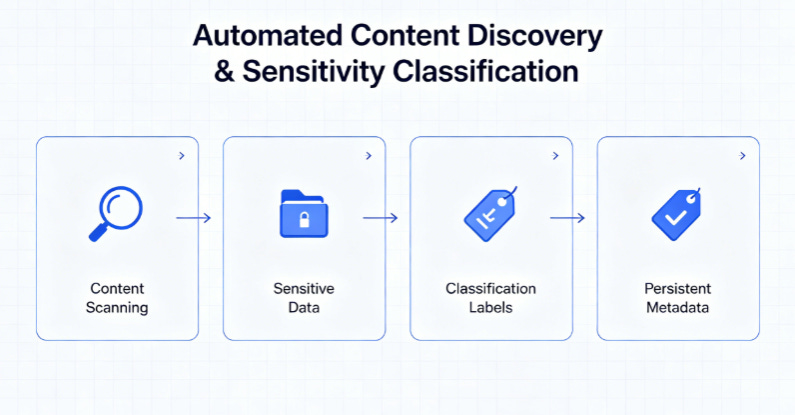
Ping32 performs continuous content-aware scanning of files stored on managed endpoints, applying classification rules that recognize sensitive data patterns across hundreds of document formats and content types. Classification rules cover regulatory categories including personally identifiable information, protected health information, payment card data, and financial records, as well as organization-specific sensitive content defined by custom keyword libraries, regular expressions, and document fingerprinting templates.
When Ping32 identifies a file containing sensitive content, it assigns a classification label from the organization’s configured sensitivity taxonomy — typically spanning tiers from public through internal, confidential, and highly restricted. Classification is applied as persistent file metadata that travels with the document through copy, rename, and format conversion operations, ensuring that sensitivity context is not lost when files move between systems or change hands across departments.
The classification engine in Ping32 operates transparently in the background without interrupting user workflows. Users are notified when a classification label is applied to a document they are working with, providing educational reinforcement that builds awareness of data handling expectations without requiring manual classification steps that introduce friction and inconsistency into daily work.
Label-Driven Policy Enforcement at the Endpoint
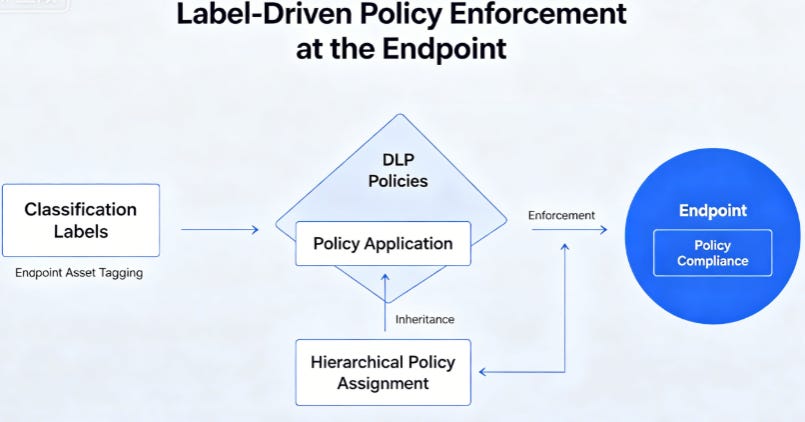
Data classification labels applied by Ping32 serve as the primary enforcement signal for DLP policies that govern how sensitive data can be used, shared, and stored. By grounding enforcement in content classification rather than location heuristics or user role alone, Ping32 ensures that protective controls follow the data wherever it travels on the endpoint rather than being limited to specific directories or application contexts.
Policy rules in Ping32 evaluate the classification label of files involved in user actions — such as uploading to cloud storage, attaching to email, copying to a USB device, or printing — and apply the appropriate enforcement response. A file labeled as highly restricted may be blocked from upload to any cloud storage service while a file labeled as internal may be permitted to upload to the organization’s approved collaboration platform but blocked from transfer to personal storage accounts.
Ping32 supports policy inheritance and override workflows that allow department-specific classification rules to extend the organization’s baseline taxonomy without creating governance fragmentation. Sensitive files identified by department-level rules receive both the department label and the corresponding organizational sensitivity tier, enabling consistent enforcement across policy boundaries while preserving the contextual specificity that makes classification actionable for data owners.
Audit Trail and Compliance Reporting for Classified Data
Ping32 maintains a comprehensive audit trail of all events involving classified files, recording each access, modification, transfer, and policy enforcement action with the full context of the user identity, endpoint, timestamp, and classification label involved. This audit trail provides the evidence base required for compliance reporting under regulatory frameworks that mandate demonstrable control over sensitive data handling.
The Ping32 management console provides pre-built compliance reports that aggregate classification event data into formats aligned with common audit requirements. Reports covering classification coverage rates, policy enforcement statistics, and exception handling history give compliance teams the documentation needed to demonstrate due diligence to regulators and auditors. Trend reports showing changes in the sensitive data footprint across the endpoint population support data governance programs by identifying departments or user groups whose data handling patterns require additional attention or training.